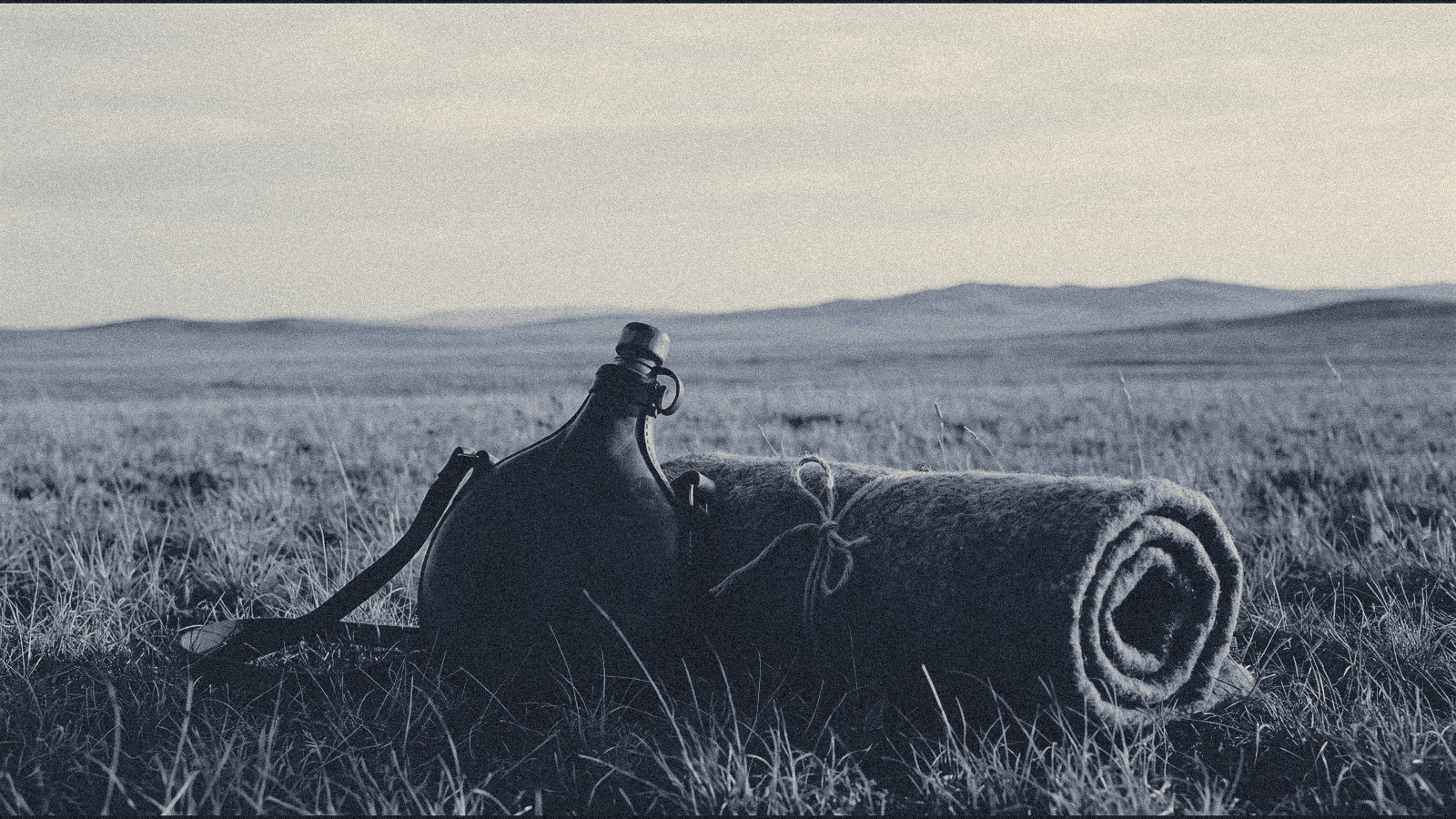
Steppe herders were never built for milk. They fermented and dried it into food that travelled with the army, walked on its own legs and renewed itself daily.
The Mongol conquests are usually explained with three nouns, horse, bow and terror, and the explanation leaves out the thing that let the horses, the bows and the terror arrive anywhere at all: lunch. The armies that rode out of Mongolia in the thirteenth century carried their food supply on the hoof and ate what their herds produced, and the most important of those products was milk. That much is not controversial. The part worth arguing about is the explanation people reach for next, which is biological: a people that lived on milk, the reasoning goes, must have been built to digest it. For a long time that assumption was not only popular but close to a textbook rule, that a population that milked animals would in time evolve the gene to drink the milk.1 On the eastern steppe the evidence says the opposite. The herders who founded Mongolian dairying could not digest lactose as adults, and most Mongolians still cannot. They did not change their bodies to fit the milk. They changed the milk to fit their bodies.
That distinction sounds like a footnote. It is the whole story, because a trait is something you are born with and a technique is something you can carry, teach and scale. An army cannot march on a gene it does not have. It can march on a skin bag of fermented mare's milk and a sack of curds dried as hard as stone.
The herders who could not drink milk
The direct evidence comes from teeth. In 2018 a team led by Choongwon Jeong, working with Christina Warinner's group, published genomes and ancient proteins from twenty-two directly dated Late Bronze Age burials in Khövsgöl province in northern Mongolia, dated to roughly 1380 to 975 BCE and associated with the Deer Stone–Khirigsuur culture and with the beginnings of pastoralism in the region.2 The dental calculus of nine of those individuals, the mineralised plaque that traps whatever passes through a mouth, was run through mass spectrometry. Seven of the nine carried milk proteins, all from ruminants: sheep, goat and bovine. These people were drinking or eating dairy. And not one of the individuals whose DNA was analysed carried the European genetic variant for lactase persistence, the ability to keep producing the lactose-digesting enzyme into adulthood.2
The same study found something that closes off the obvious escape route. These herders were not recent migrants carrying a western milk-drinking heritage with them. Their ancestry was overwhelmingly local, descended mainly from earlier hunter-gatherers of the Baikal region, with only around seven percent from Western Steppe herders.2 What spread across the steppe was a practice, not a population. The animals and the know-how moved; the gene largely did not.
A 2020 study by Shevan Wilkin and colleagues pushed the timeline back. Analysing dental calculus from sites across Mongolia spanning five thousand years, the team found dairy consumption on the eastern steppe by around 3000 BCE, and horse milking by around 1200 BCE, arriving together with the first evidence of horse riding in the region; later individuals from the period of the Mongol Empire also show camel milk.3 Five millennia of dairying, then, and the genetic adaptation that is supposed to follow dairying never took hold. A 2020 review in PLOS Biology by Laure Ségurel and colleagues calls Central Asia the exception to the textbook rule: the European persistence variant was present in the region by the end of the Bronze Age and has hovered around five percent ever since, while herders there remain mostly unable to digest lactose, even though contemporary Mongols take around thirty-five percent of their summer food energy from dairy.4
How rare is persistence in Mongolia today? The answer depends on how you measure it, and the measurements do not quite agree. Jeong's team, counting the genetic marker, puts it below five percent.2 Ségurel's review, citing studies that test digestion directly, gives phenotypic persistence of twelve to thirty percent among Mongol and Kazakh herders.4 The gap between the two methods is not resolved here, but it does not rescue the biological story: on either count, most of the people who built one of the most milk-dependent diets on earth could not digest milk sugar.
Nor is that unusual. It is the human default. Roughly sixty-five percent of people lose much of their ability to digest lactose after infancy, and among people of East Asian descent the figure runs from seventy to one hundred percent.5 Persistence is the anomaly, common in northern Europe and in some pastoral populations of Africa and the Middle East, and it did not arise once. A 2007 study of 470 people in Tanzania, Kenya and Sudan identified African variants that sit on different genetic backgrounds from the European one and from each other: separate mutations, selected separately, for the same result.6 And even in Europe the gene came after the dairy. The earliest farmers of northern Europe were straining curds from whey in perforated pots in the sixth millennium BC, when persistence was still rare among them.7
They did not change their bodies to fit the milk. They changed the milk to fit their bodies.
Changing the milk instead of the body
Lactose is a sugar, and sugar is food for microbes. Let bacteria and yeasts work on milk and they eat the lactose, turning it into lactic acid, and in the case of mare's milk into a little alcohol and carbon dioxide as well. Mare's milk needs this more than most. It is unusually rich in lactose, and a 2016 study of traditional airag, the Mongolian fermented mare's milk, gives the fresh milk at 6.4 percent lactose and notes its strong laxative effect. The airag samples collected in Ulaanbaatar held between 0.10 and 3.36 percent lactose, with 1.44 to 2.33 percent alcohol.8 Fermentation does not remove every trace, but it removes a great deal, and what remains is easier to tolerate: Ségurel's review cites studies in which people eating yogurt and kefir reported sixty to eighty percent fewer symptoms than with unfermented milk, probably because the live bacteria go on digesting lactose inside the gut.4 The same review raises the possibility that the gut microbiome of habitual dairy eaters adapts too, notably with more Bifidobacterium. That is a hypothesis, not a settled finding.
Separation is the other half of the method. When milk is curdled and strained, most of the lactose leaves with the watery whey, and the fat and protein stay in the curd. That is what the perforated pots of Neolithic Poland were for, and the authors of that study read them explicitly as a way for people who could not digest lactose to eat dairy anyway.7 Dry the curd and you have also solved a second problem, which is time.
The best description of the whole system comes from a Franciscan friar who was not trying to describe a system. William of Rubruck travelled to the Mongol court in 1253–55 as an envoy of Louis IX of France, and his report, in William Woodville Rockhill's 1900 translation, spends pages on what his hosts ate and drank.9 He watched the mares milked with their foals tied along a rope, and the milk poured into a large skin and beaten with a hollow-ended club until it began, in Rockhill's rendering, "to boil up like new wine and to sour or ferment." They drank it once it turned mildly sharp. He described cow's milk boiled down into butter that kept without salt, and the milk left over after the butter soured, boiled and curdled, and the curd dried in the sun until it became, in Rockhill's phrase, "as hard as iron slag," then stored in bags for winter. When the fresh milk gave out, they dissolved this dried sour curd, which Rubruck heard called gruit, in water in a skin and drank the sour liquid instead. He adds that they took great care never to drink plain water.9
Every step in that account is a lactose-reducing step. Fermenting the mare's milk, churning out the butter, souring and boiling the remainder, straining and drying the curd: Rubruck is describing, without knowing it, a food system engineered around a digestive limit. The dried curd survives in Mongolia today as aaruul, made in summer when milk is plentiful, usually from cow, sheep, goat or yak milk, and kept for months as a travel food and winter staple; mare's milk, by contrast, generally goes to airag rather than cheese.10
This is the same shape of argument as the essay on the vault at Ctesiphon, where a river valley with no structural timber did not produce a lost secret but a building method that never needed a wooden frame. A hard constraint, answered by technique, refined over generations until the answer looks like magic to anyone who does not know the constraint was there. The steppe had grass that humans cannot eat, animals that turn grass into milk, and human bodies that could not digest the milk. The technique was the part in the middle.
A supply chain that walked
Now put that food on a horse. The Mongol Empire, founded by Genghis Khan in 1206, came to stretch from the Pacific to the Danube and the Persian Gulf, the largest contiguous land empire in history. Even the conqueror's birth year is uncertain: 1155, 1162 and 1167 have all been proposed, and 1162 is the date favoured in Mongolia today. He died in 1227.11 The distances involved were not the kind any pre-modern army could cover by hauling its food behind it in carts.
Marco Polo's book, as translated by Henry Yule, makes the connection directly. In its chapter on the Tartars' customs of war it says that they could, in need, go a month without any supply of food, living on their mares' milk and whatever game they could shoot, while their horses lived on grass and needed no barley or oats carried for them. On long expeditions, it says, a rider took little more than two leather bottles for milk, a small pot for meat and a small tent. They carried milk dried into a paste, which they mixed with water and beat until it dissolved, and drank as a meal.12 Two details need care. The vivid specifics, ten pounds of dried milk per man and half a pound shaken up each morning in a leather bottle as the rider went along, appear in the text only in square brackets, which Yule used to mark material found only in Ramusio's sixteenth-century Italian version; Ramusio's version is also the source for a figure of eighteen animals per man, which Yule printed with a question mark.12 And the book's claim that riders in extreme haste lived on blood drawn from their horses' veins belongs to a family of such stories that Yule himself collected in his notes, some of which later observers dismissed as exaggeration.12 Polo's reliability has long been argued over, most sharply in the 1990s when Frances Wood questioned whether he reached China at all; Hans Ulrich Vogel's 2013 study of his accounts of Yuan currency and salt makes a strong case that he did, but the book survives in some 150 manuscripts that differ from one another, and no single number in it is safe to lean on.13 What the dried-milk passage does have going for it is agreement with Rubruck, an independent witness, on the substance.
The military historian Wayne E. Lee has worked through the arithmetic that the chroniclers left implicit. The sources give anything from two to eighteen horses per warrior, and most historians have settled on five or six, mostly mares, because mares give milk. Lee estimates that a half-pound of mutton and two quarts of airag a day would give a rider at least 3,300 calories, and that a handful of horses and a sheep or two could keep a steppe warrior going for a campaign of up to two-thirds of a year. He also stresses that there were two ways of moving. Fast strike forces rode light on their strings of horses; larger armies moved with a base train of families, flocks and ox-carts, some carrying siege equipment, a scheme he credits to the historian John Masson Smith.14 Those are modelled estimates, but the logic does not depend on the exact figures. A remount herd of mares is transport, reserve mounts and a daily food ration at the same time.
Rubruck gives a sense of the scale at the top: he reports that Batu received the milk of three thousand mares every day, brought in by thirty men stationed around his camp.9 Rounded or not, that is an administrative system for turning grassland into rations.
This is where the Montgisard argument wants extending. An army is a number plus the ability to put that number in one place. Saladin lost in 1177 partly because his army had come apart to forage and his baggage train, the food and the spare mounts, had bogged down at a crossing behind the main body. The baggage was separate from the fighting force, and when it stalled the force was cut off from its own food and spare horses. For its fast columns, the Mongol answer was to abolish the distinction. The spare mounts were the baggage. The baggage walked at the speed of cavalry, fed itself on the ground it crossed, and replaced itself by breeding. Food that is portable, that keeps for months once dried, and that renews itself every day it grazes is not a supporting detail of a mobile army. It is what makes the mobility possible.
The spare mounts were the baggage. The baggage walked at the speed of cavalry, fed itself on the ground it crossed, and replaced itself by breeding.
Where the grass ran out
An argument that explains everything explains nothing, so here are the limits, and they are part of the case rather than exceptions to it.
First, grass. A food supply that grazes is a food supply that needs pasture, and pasture sets a ceiling. In 1972 the Inner Asian historian Denis Sinor pointed out that Chinese sources of the period say the Mongols did not feed their horses fodder at all, and that feeding grain to a horse army of that size would have been impossible; he cited a nineteenth-century Chinese budget implying something like fifteen hundred camel-loads of grain a day for a hundred thousand horses. He then applied the logic to the most famous unexplained Mongol retreat, the withdrawal from Hungary in 1242 after crushing Hungarian resistance the year before. Working from range-management figures, Sinor estimated that the Hungarian Plain could have supported the mounts of fewer than seventy thousand warriors at three horses each, and only if no other animal grazed there, and he argued that Batu withdrew to the far larger grasslands of the south Russian steppe because Hungary could not feed his army.15 Sinor was candid that his calculation had too many unknowns to be precise. The dispute is still open. The Franciscan John of Plano Carpini, who travelled to the Mongols in the 1240s, tied the withdrawal to the death of the great khan Ögödei, an explanation Sinor thought did not fit.15 In 2016 Ulf Büntgen and Nicola Di Cosmo proposed that an unusually wet, cold spring in 1242 had turned the plain to marsh and reduced both pasture and mobility; in 2017 Zsolt Pinke and colleagues replied that the same rains would have improved pasture, not ruined it, and that the explanation lies elsewhere.16 Both sides argue in terms of pasture and food supply, which is itself the point.
The same question hangs over Syria. In 1260 Hülegü took Aleppo and Damascus fell to his forces, then he withdrew most of his army north to Azerbaijan, leaving his general Ket-Buqa with a much smaller force that the Mamluks defeated at Ayn Jalut later that year. Historians offer two explanations for the withdrawal that are not mutually exclusive: news of the great khan Möngke's death and the prospect of trouble with the Golden Horde, or, as David Morgan argued, that Syria simply lacked the pasture and water to keep a large Mongol army through the summer.17 The pasture argument is strong, but it is an argument, not a record.
Second, climate. A 2014 tree-ring study by Neil Pederson and colleagues found that the rise of the empire in the early thirteenth century coincided with about fifteen years of persistently wet conditions in central Mongolia, unmatched in the previous thousand years, which likely meant unusually productive grassland during the empire's rise.18 Productive grass means more animals, more milk and more horses. The authors call that moisture fuel for the empire, not its cause, and the evidence supports no more than that. A milk-and-grass army was riding a good run of seasons.
Third, the milk was never the whole menu. Rubruck, the same witness who described the airag, noted that the great lords had villages in the south from which millet and flour were brought for the winter.9 Lee's own ration model includes meat. And there is a nutritional limit the technique cannot remove: people who do not digest lactose still cannot get glucose from it, so what they gain from dairy comes mainly from its fat and protein.4 Armies in settled country also took what they found: Sinor points to contemporary reports of famine in Hungary after the invasion, and of the care the invaders took to secure food for themselves and their animals.15 Milk explains how the armies could reach so far and move so fast across open country. It does not explain everything they did when they arrived, and the places where the conquests stalled look suspiciously like the places where the grass ran short.
Technique, not trait
The Mongols did leave a mark in the human gene pool, and the contrast is instructive. In 2003 Tatiana Zerjal and colleagues found a single male lineage carried by about eight percent of men across a large region of Asia, around half a percent of all men alive, which appeared to have originated in Mongolia roughly a thousand years ago; they proposed, as an inference rather than a proof, that it spread through Genghis Khan's male-line descendants, a kind of social selection driven by conquest and by powerful men fathering many children.19 If that inference is right, the conquests reshaped a Y chromosome through who had children with whom. They did not produce a people built for milk, and nothing about their success required one.
Something similar is true of the steppe's other great expansion into the west. In the essay on how Anatolia became Turkish, the pattern was a small, mobile, horse-borne minority whose language and institutions spread far further than its genes. Steppe power keeps turning out to be about what those people knew how to do rather than what they were born as.
None of this is a new discovery. The argument that dairying, not only horses, underwrote the successive empires of the eastern steppe belongs to researchers like Christina Warinner and her colleagues, who have made it in print and in public.1 The general lesson is what matters. When a historical success gets credited to biology or destiny, to a people supposedly built for the saddle, or born to the sword, or physically suited to the milk, it is worth asking whether a technique is hiding under the trait. Biology is a comfortable explanation because nobody can copy it and nobody has to learn it. Techniques are less flattering and more useful. They can be observed, as Rubruck observed them. They can be counted, as Lee counts calories and horses. And they have limits you can find, in the size of the Hungarian Plain or the summer pastures of Syria.
The herders of Bronze Age Khövsgöl could not digest the milk their animals gave them. More than two thousand years later their successors rode to the Danube on it. The gap between those two facts was not closed by evolution. It was closed by a skin bag, a churning stick, a sunny week and a sack of curds as hard as iron slag.
Ancient texts are cited by their standard references. The modern editions below were consulted, not quoted: every rendering of an ancient sentence in this essay is my own paraphrase, and is marked as such where it appears. Pre-1930 work is quoted directly where it is quoted at all.
- 1Jonathan Shaw, "Dairy culture on the Eurasian Steppe" (on the work of Christina Warinner), Harvard Magazine, 6 August 2020; Virginia Gewin, "What Mongolia's Dairy Farmers Have to Teach Us About the Hidden History of Microbes," Discover, 12 February 2020 — on the older assumption that dairying followed the lactase-persistence gene, and on Warinner's argument that dairying underpinned steppe empires. ↩
- 2Choongwon Jeong, Shevan Wilkin, Tsend Amgalantugs, Abigail S. Bouwman et al., "Bronze Age population dynamics and the rise of dairy pastoralism on the eastern Eurasian steppe," Proceedings of the National Academy of Sciences 115, no. 48 (2018): E11248–E11255 — 22 Late Bronze Age individuals, Khövsgöl, c. 1380–975 BCE; milk proteins in 7 of 9 individuals' dental calculus (sheep, goat, Bovinae); no lactase-persistence allele; c. 7% Western Steppe herder ancestry; LP <5% in contemporary Mongolia. ↩
- 3Shevan Wilkin, Alicia Ventresca Miller, William T. T. Taylor et al., "Dairy pastoralism sustained eastern Eurasian steppe populations for 5,000 years," Nature Ecology & Evolution 4 (2020): 346–355 (published 2 March 2020); with the Max Planck Institute summary as reported by Phys.org, 2 March 2020, on camel milk in Mongol-period individuals. ↩
- 4Laure Ségurel, Perle Guarino-Vignon, Nina Marchi et al., "Why and when was lactase persistence selected for? Insights from Central Asian herders and ancient DNA," PLOS Biology 18, no. 6 (2020): e3000742 — LP phenotype 12–30% in Mongol and Kazakh herders; 35% of summer dietary energy from dairy; −13.910*T at c. 5% in Central Asia since the Iron Age; 60–80% symptom reduction with fermented products; possible Bifidobacterium adaptation; non-persistent individuals cannot derive glucose from lactose. ↩
- 5MedlinePlus Genetics (U.S. National Library of Medicine), "Lactose intolerance" — approximately 65 percent of the human population with reduced ability to digest lactose after infancy; 70–100 percent among people of East Asian descent. ↩
- 6Sarah A. Tishkoff, Floyd A. Reed, Alessia Ranciaro et al., "Convergent adaptation of human lactase persistence in Africa and Europe," Nature Genetics 39 (2007): 31–40. ↩
- 7Mélanie Salque, Peter I. Bogucki, Joanna Pyzel et al., "Earliest evidence for cheese making in the sixth millennium BC in northern Europe," Nature 493 (2013): 522–525. ↩
- 8S.-H. Choi, "Characterization of airag collected in Ulaanbaatar, Mongolia with emphasis on isolated lactic acid bacteria," Journal of Animal Science and Technology 58 (2016): 10 — mare's milk 6.4% lactose; airag 0.10–3.36% lactose and 1.44–2.33% ethanol. ↩
- 9William of Rubruck, The Journey of William of Rubruck to the Eastern Parts of the World, 1253–55, as Narrated by Himself, trans. and ed. William Woodville Rockhill (London: Hakluyt Society, 1900), pp. 58–70 (on food and drink: cosmos, butter, gruit, Batu's mares, millet and flour from southern villages). Short quotations from this pre-1930 translation. ↩
- 10Slow Food Foundation for Biodiversity, Ark of Taste, "Traditionally Dried Aaruul" (Mongolia). ↩
- 11Encyclopaedia Britannica, "Genghis Khan" (birth given variously as 1155, 1162 or 1167; 1162 favoured in Mongolia; died 1227) and "Mongol empire" (founded 1206; from the Pacific to the Danube and the Persian Gulf; largest contiguous land empire in history). ↩
- 12The Book of Ser Marco Polo, trans. and ed. Henry Yule, 3rd ed. revised by Henri Cordier (London: John Murray, 1903), Book I, ch. 54, "Concerning the Tartar Customs of War," with Yule's notes 3–5; Yule's introduction on the use of square brackets for passages peculiar to Ramusio's version. Paraphrased. ↩
- 13Na Chang, review of Hans Ulrich Vogel, Marco Polo Was in China: New Evidence from Currencies, Salts and Revenues (Leiden: Brill, 2013), Reviews in History (Institute of Historical Research), October 2014 — on Frances Wood's skepticism and the manuscript tradition. ↩
- 14Wayne E. Lee, "When the Mongols Set Out to Conquer the World, There Was Only One Limiting Factor: Grass," MHQ: The Quarterly Journal of Military History, via HistoryNet, 15 March 2022 — horses per warrior, ration and calorie estimates, and John Masson Smith Jr.'s two logistical arrangements. ↩
- 15Denis Sinor, "Horse and Pasture in Inner Asian History," Oriens Extremus 19 (1972): 171–183 — no fodder for Mongol horses; grain-load estimate; carrying capacity of the Hungarian Plain; the 1242 withdrawal; Carpini's explanation; famine in Hungary. ↩
- 16Ulf Büntgen and Nicola Di Cosmo, "Climatic and environmental aspects of the Mongol withdrawal from Hungary in 1242 CE," Scientific Reports 6 (2016): 25606; Zsolt Pinke, László Ferenczi, Beatrix F. Romhányi, József Laszlovszky and Stephen Pow, "Climate of doubt: A re-evaluation of Büntgen and Di Cosmo's environmental hypothesis for the Mongol withdrawal from Hungary, 1242 CE," Scientific Reports 7 (2017): 12695. ↩
- 17Encyclopaedia Iranica, "Hulāgu Khan," and "Il-Khanids i. Dynastic History" — on Hülegü's withdrawal from Syria in 1260, Möngke's death, the Golden Horde, and the suggestion (citing David Morgan, 1985) that Syria lacked pasture and water for his army. ↩
- 18Neil Pederson, Amy E. Hessl, Nachin Baatarbileg, Kevin J. Anchukaitis and Nicola Di Cosmo, "Pluvials, droughts, the Mongol Empire, and modern Mongolia," Proceedings of the National Academy of Sciences 111, no. 12 (2014): 4375–4379. ↩
- 19Tatiana Zerjal, Yali Xue, Giorgio Bertorelle et al., "The genetic legacy of the Mongols," American Journal of Human Genetics 72, no. 3 (2003): 717–721. ↩
Discussed here Mongol Empire · kumis · lactase persistence
More writing →