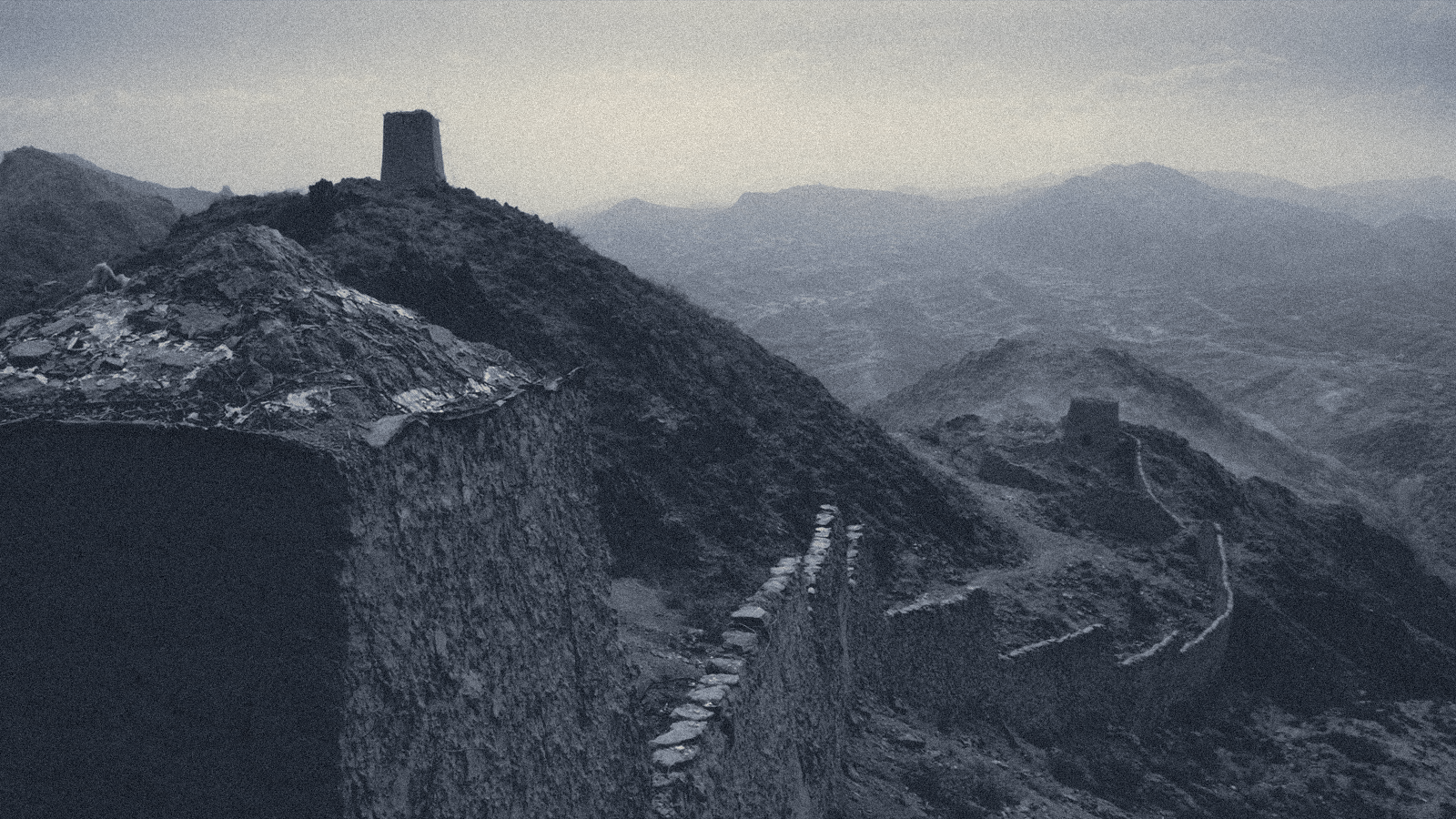
The Great Wall controlled movement both ways. In 33 BC a Han frontier officer warned that slaves were fleeing to the steppe, and the emperor kept the garrisons.
The Great Wall is remembered as a line built to keep the steppe out. For most of its long and broken history it did something wider. It controlled movement across the frontier in both directions: herds and herders, traders and raiders, runaway slaves, mutinous soldiers and ordinary subjects who had decided that life was better on the other side. That is not a modern reading forced onto old stones. In 33 BC the ruler of the Xiongnu offered to guard the frontier himself and asked the Han court to stand its garrisons down. The court's advisers all thought this convenient. One official who knew the border wrote out ten reasons to keep it manned, and four of them were about people leaving China, not about enemies entering it. The emperor kept the garrisons, and the message he sent back to the Xiongnu said plainly that China's barriers existed to stop its own wrongdoers getting out, as well as to guard against what lay beyond.1 The wall faced in as well as out. Not in its masonry, which mostly looks north, but in what it was for.
There was never one wall
The first thing to set aside is the single wall. The historian Arthur Waldron argued that the idea of one continuous ancient Great Wall, standing since the First Emperor, is a modern myth. What exists is a long series of separate walls, built by different states in different centuries for different reasons, and the brick-and-stone sections that visitors walk near Beijing are the work of the Ming dynasty, which came to power more than fifteen hundred years after Qin.2 Asking what "the" wall was for is therefore the wrong question. The better question is what each wall was for, and the answers turn out to have a great deal to do with people going out.
Start with the earliest ones. The walls of the Warring States kingdoms and of Qin are usually pictured as a farmer's fence against the nomad. Nicola Di Cosmo, in his study of early China's northern frontier, argued nearly the opposite. The northern walls did not trace a natural boundary between the sown and the steppe. They were built well inside land that had belonged to herding peoples, to hold pastures the Chinese states had recently taken. On his reading, the expansion ran from south to north, and the walls were the fence posts of a land claim. The Qin campaign against the Xiongnu in the Ordos in 215–214 BC, which produced a long stretch of the First Emperor's wall, fits the same pattern: conquest first, then a wall around what had been conquered.3 It is one historian's reading, argued at length rather than settled, but it changes the picture at once. A wall built around newly taken grazing land is not a shield for an old homeland. It is a claim that has to be policed, and policed from both sides.
The Han court's own frontier officials understood the walls as a system, not a line. The same official who argued against disbanding the garrisons in 33 BC reminded the emperor that the frontier works were not all rammed earth. Some ran along mountain rock; some were barricades of felled timber; some were water gates across stream beds; and conscripts and convicts had been building and patching them for more than a century at a cost nobody could reckon.1 What he was defending was an apparatus of watchtowers, beacons, garrisons and gates. An apparatus of that kind can be pointed in any direction.
Ten reasons, and four of them are about leaving
The scene is recorded in the Han dynastic history, the Hanshu, in the chapter on the Xiongnu. In 33 BC the Xiongnu ruler Huhanye came to court, was given the palace lady Wang Zhaojun as a bride, and offered in return to guard the frontier from Shanggu in the east to Dunhuang in the west, for ever, if the emperor would withdraw the soldiers and officials who manned it. The court's advisers agreed that this would be convenient. A palace gentleman named Hou Ying, described as experienced in frontier affairs, did not, and when the emperor asked why, he gave ten reasons.1
Some of them are what anyone would expect. The first is geography: the Yin Mountains, beyond the frontier, had been the Xiongnu's hunting park and base until the Han took them, and to abandon the watch would hand the advantage back. The second is that nomad rulers are humble when weak and arrogant when strong. The third is a shrewd one: Chinese commoners break the law despite every punishment, so how could the Xiongnu ruler guarantee that none of his people would break a treaty?
Then the argument turns. The fourth reason begins with a general principle: even inside China, passes and bridges are set up to control the great lords and to cut off the ambitions of subjects. The frontier posts, Hou Ying says, are not there for the Xiongnu alone. They are also there for the surrendered peoples settled under Han rule, who were Xiongnu by origin and might, missing their old home, run back to it. The sixth reason is about the families of soldiers who had marched out and never come home: their descendants were poor, and might one day slip out to join relatives on the other side. The seventh is the most striking. The slaves of people on the border, he says, are miserable, and many of them want to run. They say they have heard that life among the Xiongnu is happy, and complain that the watch is simply too tight; even so, some of them get out. The eighth is about bandits and outlaws, who, when cornered, would flee north beyond the reach of the law.1
One textual note matters here, because the seventh reason is the heart of the matter. The widely used Wikisource transcription of this chapter reads the key clause with the numeral "seven" in place of the character for "flee", which makes nonsense of it. Two other transcriptions of the same chapter read "flee", giving the natural sense: yet from time to time some do flee beyond the frontier.1 The reading is secure. A Han officer, arguing for the frontier to the emperor's face, counted slaves escaping to the steppe among the reasons it had to stay manned.
A Han officer, arguing for the frontier to the emperor's face, counted slaves escaping to the steppe among the reasons it had to stay manned.
Four of the ten reasons, then, concern outflow: surrendered nomads going home, soldiers' families going to find their relatives, slaves going to a life they had heard was better, and outlaws going wherever the law could not follow. None of them is about an army coming south.
The emperor's answer
Hou Ying won. The emperor issued an edict that there was to be no more discussion of disbanding the frontier, and sent a senior general to explain the decision to the Xiongnu ruler in person. The explanation is a remarkably direct statement of the wall's double function. China, the message ran, has passes, bridges, barriers and forts on all four sides. They are not only there to guard against what lies outside the frontier. They are also there to stop wicked and unruly people inside China from going out and doing harm, which is why the laws are made clear, to keep the people of one mind.1 The court's reply was diplomatic, since it had to refuse a generous offer without insult, but the diplomacy works precisely because the reason given was true enough to be said aloud.
Two thousand years later, the geographer and historian Owen Lattimore reached the same conclusion from the other end. Writing in 1940 about the Inner Asian frontier as a whole, he argued that an imperial boundary described as defensive in fact had a double function: to keep outsiders from getting in and to prevent insiders from getting out. Chinese who went too far beyond the wall ended up farming or trading for the steppe rather than for China, and so, in his words, the state had to "keep the Chinese in China as well as to keep the barbarians out". In a footnote he pointed to Chinese statesmen of the first century BC who gave reasons for holding the frontier that had more to do with controlling Chinese than with repelling invasion.4 Hou Ying is exactly the kind of statesman he meant.
The instinct was older than the Han. Among the Qin statutes found in 1975 in a tomb at Shuihudi, in Hubei, a clause in the rules on travelling persuaders punishes anyone who helped a native of Qin get out of the state and struck him from the household register. Offenders with a rank of shangzao or above were sentenced to hard labour; those below were mutilated and made chengdan, convict labourers of the category whose name refers to building walls.5 The Qin state counted its people, and the register was the other half of the wall. A body that left without being struck off was a loss in the ledger; a body struck off to help it leave was a crime.
Walls as corrals
If the Chinese sources say the frontier controlled movement, the archaeology of walls further north says so in earth and ditch. Gideon Shelach-Lavi and colleagues have surveyed a 737-kilometre medieval wall running from northern China into north-eastern Mongolia, built by either the Liao or the Jin dynasty between the eleventh and thirteenth centuries. They framed the question explicitly: were such long walls defences against aggressive nomads, or instruments for controlling the movement of local nomadic groups after an imperial expansion? The line's many auxiliary structures, mapped by survey and spatial analysis, were their evidence for how it actually worked.6
Excavation on the Mongolian stretch of that system, published in 2025, makes the answer concrete. Where the line existed at all (there are gaps where neither wall nor trench was built), it was in places a shallow trench that could easily be crossed. One excavated enclosure sat on a slope from which its occupants could not even see over the trench line. The excavators concluded that this section was not designed to stop armies. It marked the edge of Jin control, may have channelled people and their herds towards gates where crossing was easier, and put forts close enough together for the garrison to see who was crossing and stop them if necessary. The project's broader conclusion is that parts of the system were more concerned with managing the movement of people, animals and goods than with repelling large attacks, and that it worked as a symbolic boundary rather than a regimented defence.7
A trench a herd can walk through is useless as a rampart and perfectly good as a corral. It does not stop anyone determined to cross. It makes crossing somewhere other than the gate slow, visible and suspicious, which is all a customs line needs to do.
The Chinese who left
The Ming built the walls people now picture, and the Ming record shows with painful clarity who was leaving. In 1533 soldiers of the Datong garrison mutinied; afterwards, according to Ming accounts, the mutineers crossed the border and went north to the tribes of Altan Khan, several thousand of them by one record.8 They were not the last. By the 1540s there were Chinese settlements on the Mongol side of the line, called Bayising in Mongolian, a word some scholars derive from the Chinese for "ordinary people". A Ming chronicle of the Wanli reign records that in 1546 Altan Khan built a city of brick and began farming with oxen, and the official History of the Ming describes Bayising as places where Chinese who had fled gathered, raised walls for defence, built halls and cultivated fields.8
Ming reports give the settlements a population of a hundred thousand and credit one leader, Zhao Quan, with more than ten thousand followers and fifty thousand horses. The figures come from alarmed officials and should be read that way, but the alarm itself is evidence. Among the settlers were mutineers, people captured in raids, and followers of the White Lotus sect; Zhao Quan and another leader, Qiu Fu, were White Lotus men who had gone over to the Mongols. Ming officials complained that these defectors taught the Mongols how to attack fortresses. The Bayising farmed for the steppe, which is exactly what Lattimore said the state feared.8
The frontier was dangerous in the other direction too. Wang Chonggu, the Ming governor-general who later negotiated peace, warned the throne in a memorial that the garrisons called people back every year, most of them captives desperate to come home, and that some commanders quietly let their soldiers kill returnees and report them as spies or enemies to collect a reward. Others who found a gap and slipped through were arrested by local officials, could not produce any documents, were treated as spies and executed.8 A line that is guarded against its own people will sooner or later start killing them at the gate.
Raids went out, and peace came through a market
The Ming frontier was also a base for going out. Ming sources speak of daochao, "smashing the nest", and ganma, "driving off horses": forays into Mongolia, usually to steal horses. In a memorial of 1561 the Minister of War, Yang Bo, described two kinds of daochao: striking the Mongols' home camps while their men were away raiding, and sending troops out to hit the camps when they were unprepared. Generals and their private retainers took credit, and profit, from these raids. In the run-up to Wang Chonggu's settlement with Altan Khan in 1571, he banned daochao and ganma on pain of death, and a Ming envoy told a Mongol chief that the generals opposed the peace because it would stop them making money from the raids.9 For the men who manned it, the wall was a business as well as a barrier.
What ended the Bayising problem was not a better wall. It was trade. The Ming court and Altan Khan made peace in 1571, and regular border markets were set up; after that, the historian Yu-lung Tseng observes, Bayising faded as a threat to the court, and the settlements went on to prosper. In 1575 the Wanli emperor granted Altan Khan's request to name his new city Guihua, "return and transform", the city that became Hohhot.8 The frontier's problem had always been movement, and the solution was to give movement a legal channel.
What ended the Bayising problem was not a better wall. It was trade.
One architectural detail deserves a straight answer, because it is sometimes offered as proof that the wall literally faced in. At Mutianyu, north of Beijing, both parapets of the Ming wall are crenellated, so the wall has teeth on both sides, and this double battlement is presented as the section's distinguishing feature. The recorded reason has nothing to do with Chinese subjects. Beijing's municipal tourism portal, reprinting a Beijing newspaper, explains the section as a northern shield for the capital and the imperial tombs, built so that its defenders could resist the enemy on both sides: raiders who had got round behind the line, not subjects trying to leave.10 The builders were worried about Mongols circling behind them, not about Chinese climbing out. The inward-facing wall is a matter of function and law, not of arrow slits.
That is the stronger claim anyway. Battlements can be read many ways; a memorial cannot. In 33 BC a frontier official told the emperor that slaves were running to the steppe because they had heard life was better there, and the emperor told the Xiongnu that China's barriers kept its own people in. The Ming governor who made peace in 1571 did it by opening markets and banning his own generals' raids. The same Qin statute book that punished helping a subject leave also made the conscripts who built a stretch of wall guarantee it for a full year, and rebuild it for nothing if it fell, a rule that says a good deal about how the Qin state organised work of every kind, from walls to the weapons of the Terracotta Army.11 The wall kept the steppe out when it could. It was also, from the first Qin fence posts in conquered pasture to the Ming border markets, a machine for deciding who was allowed to go.
Ancient texts are cited by their standard references. The modern editions below were consulted, not quoted: every rendering of an ancient sentence in this essay is my own paraphrase, and is marked as such where it appears. Pre-1930 work is quoted directly where it is quoted at all.
- 1Ban Gu, Hanshu 漢書, juan 94B (Xiongnu zhuan xia), on Huhanye's visit to court in the first year of Jingning (33 BC), the gift of Wang Zhaojun, his offer to guard the frontier from Shanggu to Dunhuang, the memorial of the palace gentleman Hou Ying giving ten reasons against disbanding the frontier garrisons (reasons 4, 6, 7 and 8 on surrendered peoples, soldiers' descendants, slaves and outlaws leaving; reason 9 on walls of rock, timber and water gates), the edict ending the debate, and the message delivered to the Chanyu on barriers that also stop wrongdoers inside China from going out. Ancient text paraphrased. Reason 7 read as 亡出塞者 ("flee beyond the frontier") with the transcriptions at arteducation.com.tw (guwen/bookv_3848) and gushiwen.cn (guwen/bookv_3848); the Wikisource transcription (漢書/卷094下) has the evident error 七出塞者. ↩
- 2Arthur Waldron, The Great Wall of China: From History to Myth (Cambridge: Cambridge University Press, 1990), on the single continuous ancient wall as a modern myth and the many separate walls built at different times. ↩
- 3Nicola Di Cosmo, Ancient China and Its Enemies: The Rise of Nomadic Power in East Asian History (Cambridge: Cambridge University Press, 2002), ch. 4, "Walls and Horses"; Di Cosmo, "The Northern Frontier in Pre-Imperial China," in The Cambridge History of Ancient China, ed. Michael Loewe and Edward L. Shaughnessy (Cambridge: Cambridge University Press, 1999), 885–966; and Yuri Pines, review of Di Cosmo 2002, Reviews in History no. 312 (February 2003), summarising the argument that Warring States and Qin walls were built deep inside nomadic territory to protect recently conquered land, and the Qin campaign in the Ordos in 215–214 BC. ↩
- 4Owen Lattimore, Inner Asian Frontiers of China, 2nd ed. (Irvington-on-Hudson: Capitol Publishing / American Geographical Society, 1951; first published 1940), ch. VIII, 240–41, on the imperial boundary's double function and the need to keep the Chinese in China, with his footnote on first-century BC statesmen. ↩
- 5Shuihudi Qin bamboo slips (Tomb 11, Yunmeng, Hubei, excavated 1975), Qinlü zachao 秦律雜抄, clause of the Youshi lü 游士律 on helping a native of Qin leave and removing him from the register (有為故秦人出,削籍,上造以上為鬼薪,公士以下刑為城旦). Text as in Shuihudi Qinmu zhujian zhengli xiaozu, Shuihudi Qinmu zhujian (Beijing: Wenwu, 1978/1990), read in the Wikisource transcription; paraphrased. The standard English translation is A. F. P. Hulsewé, Remnants of Ch'in Law (Leiden: Brill, 1985), not consulted for this clause. ↩
- 6Gideon Shelach-Lavi, Ido Wachtel, Dan Golan, Otgonjargal Batzorig, Chunag Amartuvshin, Ronnie Ellenblum and William Honeychurch, "Medieval long-wall construction on the Mongolian Steppe during the eleventh to thirteenth centuries AD," Antiquity 94, no. 375 (2020): 724–41, on the 737 km Liao or Jin wall and the question of defence against nomads versus control of their movement. ↩
- 7Gideon Shelach-Lavi et al., "Life along the medieval frontier: archaeological investigations of the south-eastern long wall of Mongolia," Antiquity 99, no. 405 (2025): 850–69, on gaps in the line, a shallow trench easily crossed, the channelling of people and herds to gates, forts monitoring crossings, sections more concerned with managing the movement of people, animals and goods than with defence, and the wall as a symbolic boundary rather than a regimented defence. ↩
- 8Yu-lung Tseng, "The Cross-border Perception of Bayising (Pansheng 板升) among Government Officials in Ming China," Journal of East Asian Cultures (Távol-keleti Tanulmányok) 2024/2: 1–29, drawing on the Ming Shilu, Mingshi, Mingshi jishi benmo, Huang Ming beilu kao and Wanli wugonglu, on the 1533 Datong mutineers, the Bayising settlements, the 1546 brick city and farming, the reported population figures, Zhao Quan and Qiu Fu, Wang Chonggu's memorial on returnees killed or executed as spies, the 1571 peace and regular trade, and Guihua (1575). See also Henry Serruys, "Chinese in Southern Mongolia during the Sixteenth Century," Monumenta Serica 18 (1959): 1–95. ↩
- 9Temur Temule, "The Great Wall as Perilous Frontier for the Mongols in 16th Century: Reconsidering Nomadic-Sedentary Relations in Premodern Inner Asia," International Journal of Korean History 21, no. 1 (2016): 121–56, on daochao and ganma raids, Yang Bo's memorial of 1561, the generals' opposition to peace and Wang Chonggu's ban. ↩
- 10"慕田峪长城的烟云过往" (reprinted from Beijing Evening News), visitbeijing.com.cn, 9 October 2019, on Mutianyu's crenellation on both sides as a northern shield for the capital and the imperial tombs, to resist the enemy on both sides. A journalistic source, not an archaeological survey. ↩
- 11Shuihudi Qin bamboo slips, Yaolü 徭律 (conscripts guarantee a wall section for a full year; a collapse before the year is out makes the works official and the officer in charge guilty, and the conscripts rebuild it without credit toward their labour service) and Qinlü zachao 秦律雜抄 (garrison version). Text as in Shuihudi Qinmu zhujian (Wenwu, 1978/1990), read in the Wikisource transcription; paraphrased. ↩
Discussed here Great Wall of China · Xiongnu · Ming dynasty
More writing →