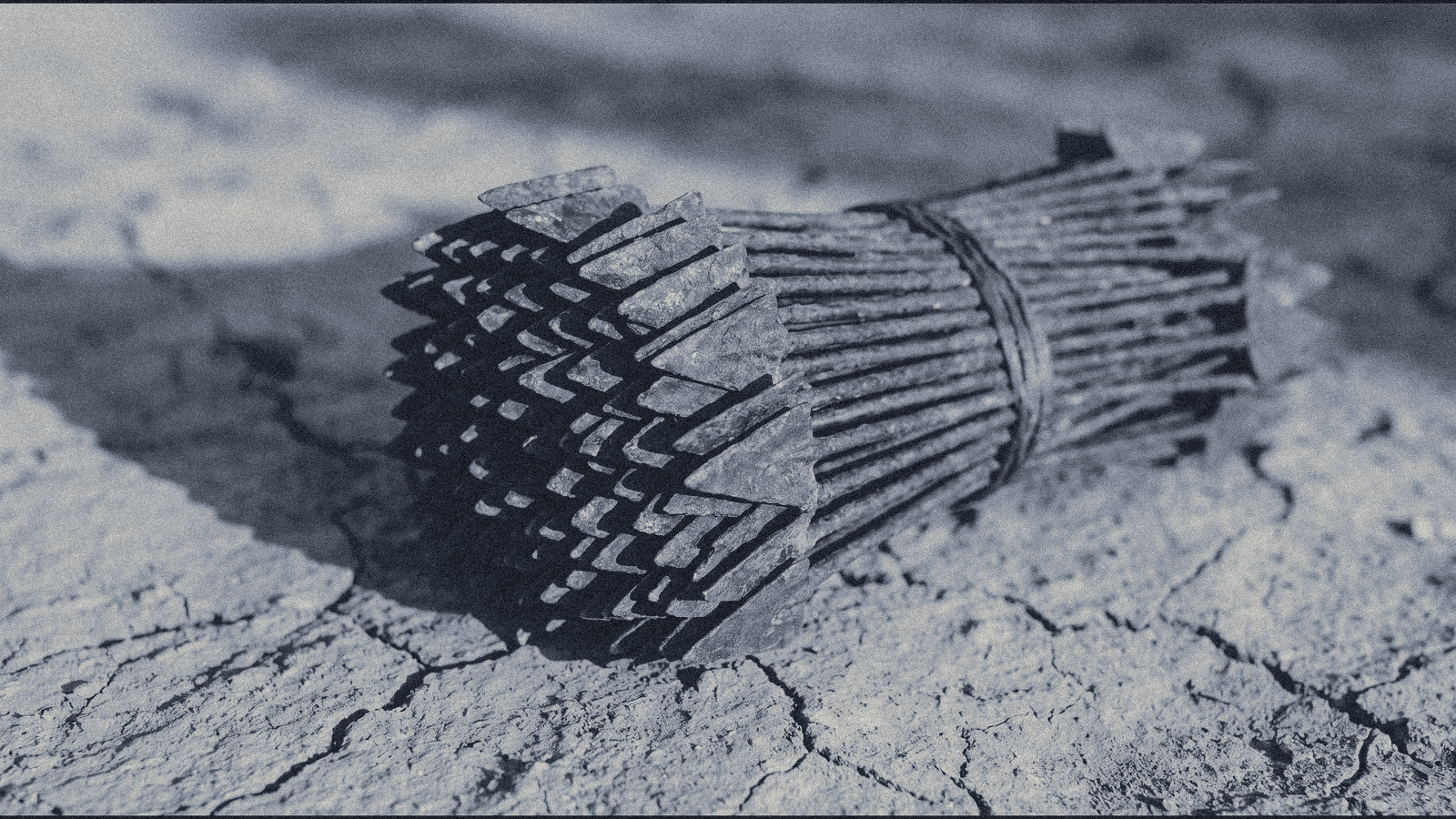
The Terracotta Army's bronze came from small teams making whole products to one central standard, held to it by named supervisors and fines graded by rank.
The arsenal that armed the Terracotta Army is easy to imagine as an ancient Ford plant: endless identical bronze parts rolling down a line, one worker per station, the whole thing driven by an empire that treated men as machines. The evidence points somewhere more interesting. Qin weapons were made by small, self-contained teams, each turning out complete products, held to one central standard by shared models and by a chain of named supervisors who answered for the results. When a workshop did badly, the law punished the people in it according to their rank: the master paid most, the managers less, the labourers least. The archaeologists who took the arrows apart chemically made the car comparison themselves, and they chose Toyota's work cells over Ford's assembly line.1 The Qin achievement was not the conveyor belt. It was a paper trail that let many independent teams make the same thing.
Forty thousand arrowheads
About forty thousand bronze arrowheads have been recovered with the Terracotta Army, most of them from Pit 1 of the First Emperor's mausoleum, and many more are still unexcavated. Each is a small three-sided point, about 2.7 centimetres long and one centimetre wide, cast separately from a bronze rod, the tang, that was pushed into a socket at its back. The tang was wrapped in linen cord and set in a bamboo or wooden shaft, making an arrow about sixty centimetres long, and the arrows were found in bundles of roughly a hundred, thought to be the remains of quivers whose woven hemp has rotted away.1
The uniformity of the points is remarkable. Xiuzhen Li measured more than sixteen hundred of them, six from each of 278 bundles. Their length varies with a coefficient of variation of 2.8 per cent and their width of 4.1 per cent. The researchers note that these figures are only just high enough for a human eye to notice a difference, and then only in a few cases, when the longest and shortest are laid side by side. Other common parts, such as crossbow triggers and the ferrules on the butts of shafts, typically vary by less than five per cent. The one real exception is the tangs, whose lengths vary by 10.9 and 13.0 per cent in their two main sizes. That was probably tolerated because the tangs disappeared inside the shaft, invisible to supervisors and soldiers alike.1 Precision went where it could be seen and checked.
Numbers that low across tens of thousands of castings are not luck. Copying a copy of a copy lets errors pile up, generation after generation, and the researchers argue that the Qin pattern points the other way: a small number of master models, probably supplied by a central authority, used again and again to make fresh moulds, instead of each new mould being taken from whatever arrow came to hand.1 Standardisation, in other words, was sent out from the centre as physical objects.
One standard, written into law
It was also written into law. In December 1975 archaeologists opening Tomb 11 at Shuihudi, in Yunmeng county, Hubei, found a Qin local official buried with more than a thousand bamboo slips in his coffin, many of them statutes. The standard English translation, by A. F. P. Hulsewé, stresses in its introduction that these are only a selection from a much larger body of law, chosen for the use of one subordinate official.2 Even so, the selection is precise about workshops.
The Statute on Artisans states the principle in one line: when objects of the same kind are made, their size, length and width must be equal.3 The Statute on Checking shows how seriously measurement itself was policed. If an office's balance weights or grain measures were found to be inaccurate, the overseer of that office was fined on a sliding scale according to the size of the error: a balance for weighing one shi that was out by sixteen liang or more cost him a suit of armour, an error of eight to sixteen liang a shield, and similar scales ran down through the smaller weights and measures.4 A state that fines its officials for a crooked scale is a state that expects the same object to come out the same wherever it is made.
Names on bronze
The weapons carry their own paperwork. The long weapons from the pits, the halberds and lances, bear inscriptions chiselled into the bronze, giving the regnal year, the official in charge of production, the office or workshop, and the name of the worker who made the piece. From them the researchers reconstruct up to four levels of supervision and accountability, sometimes running from the chancellor of the state down to individual workers. The dated halberds and dagger-axes fall between 244 and 237 BC; the dated lances between 232 and 228 BC.1
The chancellor of Qin throughout those halberd years was Lü Buwei, appointed in 249 BC and removed in 237 BC. Halberds made under his authority are known from more than one site. The National Museum of China holds one found in 1957 in a Qin tomb at Zuojiatang, near Changsha, dated to the fourth year of King Zheng, the future First Emperor, which is 243 BC; its inscription names the chancellor Lü Buwei, the Sigong workshop and the officials below him. The museum notes that weapons supervised by Lü Buwei largely stop appearing after the ninth year of the reign, which is what the historical record of his fall would predict.5
What is not named matters as much as what is. Swords, crossbow triggers, hooks and ferrules carry only numbers, a note of the workshop, or other symbols. The arrowheads, the largest group of all, are not described as carrying makers' names.1 The marks on the triggers seem to have had a practical job. Andrew Bevan and colleagues, studying inked and incised marks on trigger parts from Pit 1, found matching marks on different parts of the same trigger, and concluded that one purpose of marking was to make sure accurately fitted parts could be matched up again. Marks identifying particular artisans, they add, are far more explicit on the terracotta warriors and on the long weapons.6 The warriors themselves carry the stamped or written names of at least 87 foremen, each probably in charge of a larger team.1
The principle behind the names was stated in the same years, and in the same chancellor's circle. The Lüshi chunqiu, the compendium compiled under Lü Buwei's patronage, sets out the duties of each month of the year. In the first month of winter, it says, the master artisans present their work for inspection, the sacrificial vessels are laid out and checked against the proper measures, and nothing extravagant is to be made; objects are to be inscribed with the maker's name so that his integrity can be tested, and if the work is not right he must be punished, to get to the bottom of it. The same passage reappears in the "Monthly Ordinances" of the later Book of Rites.7 It is a statement of an ideal, set in a seasonal calendar and naming ritual vessels first, not a weapons statute. But it describes exactly the arrangement the halberds display.
The statutes themselves were more concerned with ownership than with blame. The Statute on Artisans required state armour and weapons to be inscribed with the name of the office that held them, or written on in red pigment or lacquer where they could not be engraved. When weapons were lent out, the mark was recorded, and the weapon had to come back bearing the same mark; anything returned unmarked, or with another office's mark, was confiscated and charged for.3 The Statute on Checking fined an office's overseer a shield for any state implement left unmarked.4 The mark was an inventory tag first and a signature second.
Who paid, and how much
The clearest rule about bad work comes from a set of miscellaneous Qin statutes in the same tomb, and it is not triggered by a weapon failing in battle. It is triggered by an inspection. When workshops were assessed, the one ranked last was penalised at every level, on a descending scale. The master artisan was fined one suit of armour. His assistant and the section head were fined one shield each. The labour gang was fined twenty lengths of cord. If a workshop was ranked last three years running, the penalties rose: two suits of armour for the master, one suit each for the assistant and the section head, fifty lengths of cord for the gang.8
The master artisan was fined one suit of armour. His assistant and the section head were fined one shield each. The labour gang was fined twenty lengths of cord.
The same statutes grade punishment by status as well as rank. Where convicts sentenced to wall-building labour were working as artisans and their work was ranked last, each of them was beaten a hundred strokes. When a county workshop's newly presented products were ranked last, the workshop's overseer was fined a suit of armour and the county's overseer, assistant, officials and the section head a shield each. Where the making of large carts was ranked last, the overseer of works was fined a shield and the gang was beaten fifty strokes. A master and his assistant who made objects outside the year's assigned work, without a written order, were fined two suits of armour each.8 Men in authority paid in armour and shields; labourers paid in cord or, in some trades, with their backs; convict artisans paid with their backs.
What happened when soldiers actually received bad weapons? The statutes place that responsibility elsewhere. If weapons issued to troops were not in good repair, the fine of two suits of armour, with dismissal, fell on the assistant, the overseer of the arsenal and the officials concerned, the people who stored and issued the weapons, not the people who cast them.8 Nothing in the surviving statutes punishes a work group because a weapon broke in use. The system was built around routine inspection and ranking, which is how a manager keeps many teams honest without having to wait for a failure in the field.
It was also built around training. The Statute on Equalising Artisans says that a new artisan owed only half the normal output in his first year, and that the master artisan was to teach well: an experienced worker was expected to be trained in a year, a new one in two. Anyone who finished early was to be reported upward, and might be rewarded; anyone who had not finished when the time ran out was to be entered in a register and reported to the capital's finance official.9 The same logic of named responsibility ran through the apprenticeship.
Why not Ford
The Ford comparison fails on the chemistry. Marcos Martinón-Torres and his colleagues analysed arrowheads and tangs from eighteen bundles across Pit 1 with portable X-ray fluorescence, which reads the proportions of metals in the bronze. They found that each bundle of about a hundred arrows reflects two discrete metal batches, one for all its heads and another for all its tangs, most likely single crucible loads, and that batches were virtually never mixed between bundles.1
That is not what an assembly line produces. If one specialised unit cast heads continuously, another cast tangs, another cut shafts, and the parts met at later stations, the units would work at different speeds, build up stocks, and send parts forward in whatever order they came. Batches would end up mixed across bundles. The researchers state that this flow-line hypothesis can be falsified. They also admit that their own earlier work on grinding marks had led them to entertain a single specialised sharpening workshop, and that the batch chemistry pointed away from it. The pattern instead implies a small team that cast a hundred heads and a hundred tangs, then finished and assembled them, and probably fitted shafts and feathers, before casting the next batch. Each such unit, they propose, had its own furnaces, metal, moulds, polishing tools, bamboo and feathers, and several worked in parallel, possibly in different places.1
They then make the comparison explicitly. Fordism, as they describe it, broke tasks down so that low-skilled workers aided by specialised machines could perform them in sequence, producing as much as possible for a market assumed to absorb it. Toyota's cellular production uses smaller units of more versatile, multi-skilled workers who carry out inspection and repair as well as production, and who work to schedule rather than to stockpile. Their verdict is that the organisation of labour behind the Terracotta Army seems "much closer to Toyotism than to Fordism", a comparison they offer, they write, without implying a wider equivalence.1 The crossbow triggers point the same way. Parts that had to be matched after filing, so that particular pieces went only with each other, are the opposite of a line on which any part must fit any assembly.6
Parts that had to be matched after filing, so that particular pieces went only with each other, are the opposite of a line on which any part must fit any assembly.
The researchers are candid about what does not fit. The dated halberds and lances do not overlap in time, which is awkward if versatile cells made everything at once; the long weapons may have come from more specialised workshops, or from ordinary military stock rather than a special order for the tomb, and the sample of dated pieces is small. An anonymous reviewer suggested that the pattern could also come from elite groups presenting complete weapon "packages" to the emperor as gifts. The authors accept that this cannot be ruled out, while noting that such groups would have had to meet the same standards and deadlines.1 What survives all of these objections is the core finding: complete products from small teams, uniform because the models and the supervision were central, not because the work was chopped into stations.
The rule where the whole crew paid
There is a Qin rule that makes a whole crew answer for a failure, and it concerns walls, not weapons. The Statute on Labour Service required conscripts raised to build walls in a town to guarantee their section for a full year. If it collapsed before the year was out, the official in charge of the works and the officer responsible for that section were guilty, and the conscripts had to build it again, with none of the rebuilding counted towards the labour service they owed the state.10 A garrison version appears among the miscellaneous statutes: soldiers who built or repaired walls while on garrison duty were to guarantee them for a year; if a wall they had built was damaged, the officers commanding them were each fined a suit of armour and the works official's assistant in charge a shield, and the garrison was to be kept at the repairs and given no other tasks until they were done.8
Here the penalty for failure really does fall on the group, and much of it is paid in labour. The officers pay in armour, as the master artisan did. The men pay by doing the job twice. The structure is the same one that governed the workshops, a warranty backed by named responsibility and graded by rank, applied to rammed earth instead of bronze.
It is also a reminder of what those walls were for. The same state that fined a workshop for a poor ranking and made conscripts guarantee a wall for a year also kept registers of its people and punished those who helped them leave,8 and its Han successors defended the northern frontier partly on the grounds that their own subjects kept trying to cross it.11 That story is told in The Wall Faced In. Qin bronze and Qin walls came out of one administrative habit: count everything, mark everything, name the person responsible, and make sure the same thing comes out the same wherever it is made. The arrowheads are the proof that it worked. Forty thousand of them, cast by many hands in many batches, are almost as alike as if one hand had made them all, and the reason is not a conveyor belt. It is a chain of names.
Ancient texts are cited by their standard references. The modern editions below were consulted, not quoted: every rendering of an ancient sentence in this essay is my own paraphrase, and is marked as such where it appears. Pre-1930 work is quoted directly where it is quoted at all.
- 1Marcos Martinón-Torres, Xiuzhen Janice Li, Andrew Bevan, Yin Xia, Kun Zhao and Thilo Rehren, "Forty Thousand Arms for a Single Emperor: From Chemical Data to the Labor Organization Behind the Bronze Arrows of the Terracotta Army," Journal of Archaeological Method and Theory 21 (2014): 534–62 (UCL postprint), on the arrowheads and tangs, Xiuzhen Li's measurements (2012), the coefficients of variation, central models, pXRF batch analysis of eighteen bundles, the falsified flow-line model, multi-skilled cells, the Fordism and Toyotism comparison, the inscriptions on long weapons (after Shaanxi Institute and Museum 1988; Yuan 1984; Li et al. 2011), the 87 foremen (after Ledderose 2000), and the authors' caveats. ↩
- 2A. F. P. Hulsewé, Remnants of Ch'in Law: An Annotated Translation of the Ch'in Legal and Administrative Rules of the 3rd Century B.C. Discovered in Yün-meng Prefecture, Hu-pei Province, in 1975 (Leiden: Brill, 1985), introduction (as reprinted at xinfajia.net), on the 1,155 slips from the coffin of Tomb 11, found in December 1975, and the legal texts as a selection made for a subordinate official. ↩
- 3Shuihudi Qin bamboo slips, Gonglü 工律 (Statute on Artisans): objects of the same kind to be equal in size, length and width; state armour and weapons to be marked with the office's name, and loans checked by mark. Text as in Shuihudi Qinmu zhujian zhengli xiaozu, Shuihudi Qinmu zhujian (Beijing: Wenwu, 1978/1990), read in the Wikisource transcription; paraphrased. ↩
- 4Shuihudi Qin bamboo slips, Xiaolü 效律 (Statute on Checking): graded fines for inaccurate balances and measures; an office overseer fined one shield for an unmarked state implement. Same edition; paraphrased. ↩
- 5National Museum of China, collection entry "'四年相邦吕不韦'青铜戈" (chnmuseum.cn, 2021), on the halberd from a Qin tomb at Zuojiatang, Changsha (1957), dated 243 BC, its inscription, Lü Buwei's appointment in 249 BC and removal in 237 BC (after Shiji, "Lü Buwei liezhuan"), and the near absence of weapons supervised by him after the ninth year of King Zheng. ↩
- 6Andrew Bevan, Xiuzhen Li, Zhen Zhao, Jianhua Huang, Stuart Laidlaw, Na Xi, Yin Xia, Shengtao Ma and Marcos Martinón-Torres, "Ink marks, bronze crossbows and their implications for the Qin Terracotta Army," Heritage Science 6, 75 (2018), on matching marks on trigger parts and artisan marks being far more explicit on warriors and long weapons. ↩
- 7Lüshi chunqiu 呂氏春秋, juan 10, "Mengdong ji" 孟冬紀 (compiled under Lü Buwei's patronage, c. 239 BC), and Liji 禮記, "Yueling" 月令: 物勒工名,以考其誠;工有不當,必行其罪,以窮其情. Ancient texts paraphrased. ↩
- 8Shuihudi Qin bamboo slips, Qinlü zachao 秦律雜抄 (miscellaneous Qin statutes): fines for a workshop ranked last at inspection (省殿) and for three years running; convict artisans ranked last beaten 100 strokes; county workshops, large carts and unauthorised objects; weapons issued not in good repair charged to the assistant, arsenal overseer and officials; the Youshi lü clause on helping a native of Qin leave; the garrison wall guarantee. Same edition; paraphrased. ↩
- 9Shuihudi Qin bamboo slips, Junggong 均工 (Statute on Equalising Artisans): half output in a new artisan's first year; one year's training for an experienced worker and two for a new one; reporting of early and late finishers. Same edition; paraphrased. ↩
- 10Shuihudi Qin bamboo slips, Yaolü 徭律 (Statute on Labour Service): conscripts guarantee a wall section for a full year; a collapse makes the works official and the officer in charge guilty, and the conscripts rebuild without credit toward their service. Same edition; paraphrased. ↩
- 11Ban Gu, Hanshu 漢書, juan 94B, memorial of Hou Ying (33 BC) against disbanding the northern frontier, several of whose ten reasons concern people leaving China. Ancient text paraphrased. ↩
Discussed here Terracotta Army · Qin dynasty · Toyota Production System
More writing →